
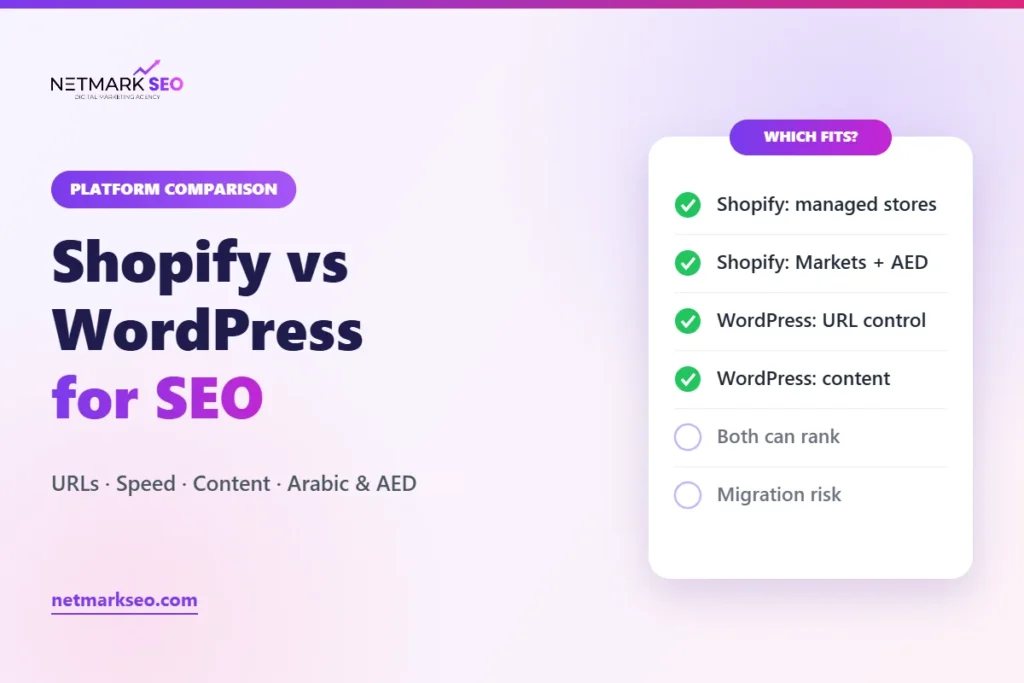
Neither Shopify nor WordPress is automatically better for SEO. Both can rank well. WordPress gives you more control over URLs, site structure and content, which suits service businesses and content-heavy sites. Shopify gives online stores a fast, secure, well-structured starting point with less technical upkeep, at the cost of some flexibility. For most UAE businesses, the right choice depends on whether you are mainly selling products online or generating enquiries for services.
Below we compare the two on the things that actually affect rankings, with notes specific to UAE businesses: Arabic, AED pricing and local search.
The short answer
| If you are… | Usually the better fit |
|---|---|
| An online store with a product catalogue, selling in AED and possibly across the GCC | Shopify |
| A service business (clinic, law firm, contractor, agency) that needs enquiries | WordPress |
| A content-led brand publishing guides and blogs as the main growth channel | WordPress |
| A store that also needs complex content, custom layouts and full URL control | WordPress + WooCommerce, or Shopify with a good developer |
| A small team with no developer that wants to launch a store quickly | Shopify |
Head-to-head on SEO factors
| SEO factor | Shopify | WordPress |
|---|---|---|
| URL structure | Fixed prefixes: /products/, /collections/, /pages/, /blogs/ | Fully customisable |
| Titles and meta descriptions | Built in for every page | Via an SEO plugin such as Yoast or Rank Math |
| XML sitemap | Automatic | Via plugin or WordPress core |
| robots.txt | Editable through robots.txt.liquid | Fully editable |
| Canonical tags | Automatic on products and collections | Via SEO plugin |
| Hosting and security | Managed by Shopify, includes SSL and a CDN | Depends on your host |
| Speed | Good baseline; apps and heavy themes slow it down | Depends on hosting, theme and plugins |
| Structured data | Most themes output Product data | Via plugins or custom code |
| Blogging | Basic | Excellent, the platform’s original purpose |
| Multilingual and multi-currency | Shopify Markets: language and country versions, adds hreflang | Plugins such as WPML or Polylang; WooCommerce for currency |
| Extensions | Apps (often a monthly fee) | Plugins (many free; quality varies) |
Where Shopify is stronger for SEO
Less can go wrong technically. Hosting, SSL, a content delivery network, sitemaps and canonical tags are handled for you. Many WordPress SEO problems we see come from cheap hosting, abandoned plugins or a theme nobody updates; Shopify removes most of that.
Built for product catalogues. Collections, product variants, structured data and Google Merchant Center integration work out of the box, so products can appear in Google Shopping’s free listings.
Selling across the GCC is simpler. Shopify Markets lets one store show AED, SAR and other currencies and create language or country versions such as /ar-ae/, with hreflang added automatically. On WordPress, the same set-up usually needs several plugins working together.
Where Shopify holds you back
- Fixed URL prefixes. You can’t remove
/products/or/collections/. This doesn’t stop pages ranking, but it limits how you structure the site. - Duplicate product URLs. Many themes link to products through
/collections/name/products/itemas well as/products/item. The canonical tag handles it, but it still wastes crawling. Our Shopify SEO checklist shows how to fix it. - App bloat. Every app that adds scripts to the storefront can slow it down, and uninstalled apps often leave code behind.
- Content flexibility. Shopify’s blog and page templates are basic compared with WordPress, which matters if content is your main growth channel.
Where WordPress is stronger for SEO
Full control. You decide every URL, the site structure, internal linking, schema and templates. For a service business with many service and location pages, that control is valuable.
Content. WordPress was built for publishing. Categories, internal linking, author pages and long-form layouts are easy to manage, which supports topical authority.
Cost of extending. Many SEO features are free plugins rather than monthly apps.
Where WordPress holds you back
- You own the maintenance. Updates, security, backups and hosting quality are your responsibility. A neglected WordPress site gets slow, and occasionally hacked.
- Plugin overload. Ten plugins doing overlapping jobs is a common cause of slow sites.
- E-commerce needs WooCommerce. It’s powerful, but a large store on WooCommerce needs good hosting and a developer.
UAE-specific points
Arabic and right-to-left (RTL) layout. Both platforms support Arabic. What matters more is the theme: test the Arabic version on a phone, especially menus, forms and prices. Whichever platform you choose, research Arabic keywords separately rather than translating English ones. See our Arabic SEO services.
Payment and checkout. Shopify Payments availability and local gateways change over time, so confirm the current options for your business licence before choosing. This affects conversions, not rankings, but it often decides the platform.
Local SEO. For service businesses, Google Maps visibility depends far more on your Google Business Profile than on your CMS. Neither platform gives you an advantage there.
Should you switch platforms for SEO?
Rarely, and only for a stronger reason than SEO alone. A migration changes URLs, templates and internal links. Done carelessly, it can undo years of rankings. If you do switch, plan redirects and benchmarks first using our website redesign SEO checklist.
Good reasons to switch:
- Your store has outgrown a WordPress set-up that’s slow and hard to maintain, and you want Shopify’s managed platform.
- Your Shopify store needs content, structure or custom features the platform can’t handle.
Frequently asked questions
Does Google prefer WordPress or Shopify sites?
No. Google ranks pages, not platforms. It looks at whether a page is crawlable, fast, useful and relevant to the search, and it doesn’t use the CMS as a ranking factor.
Is Shopify bad for SEO?
No. Shopify has a few limitations (fixed URL prefixes, duplicate collection URLs, app bloat), but all of them can be managed. Many well-ranking stores run on Shopify.
Is WooCommerce better than Shopify for SEO?
WooCommerce gives more control, while Shopify needs less technical work. A well-built WooCommerce store and a well-built Shopify store can both rank. The difference is the effort it takes to keep each one fast and clean.
Need help choosing?
We build and optimise both platforms. If you’re planning a new store, see our Shopify SEO services in Dubai. For service websites, see our web design company and our guide to website design costs in Dubai. Or ask us on +971 56 568 3130 and we’ll recommend the platform that fits your business.