
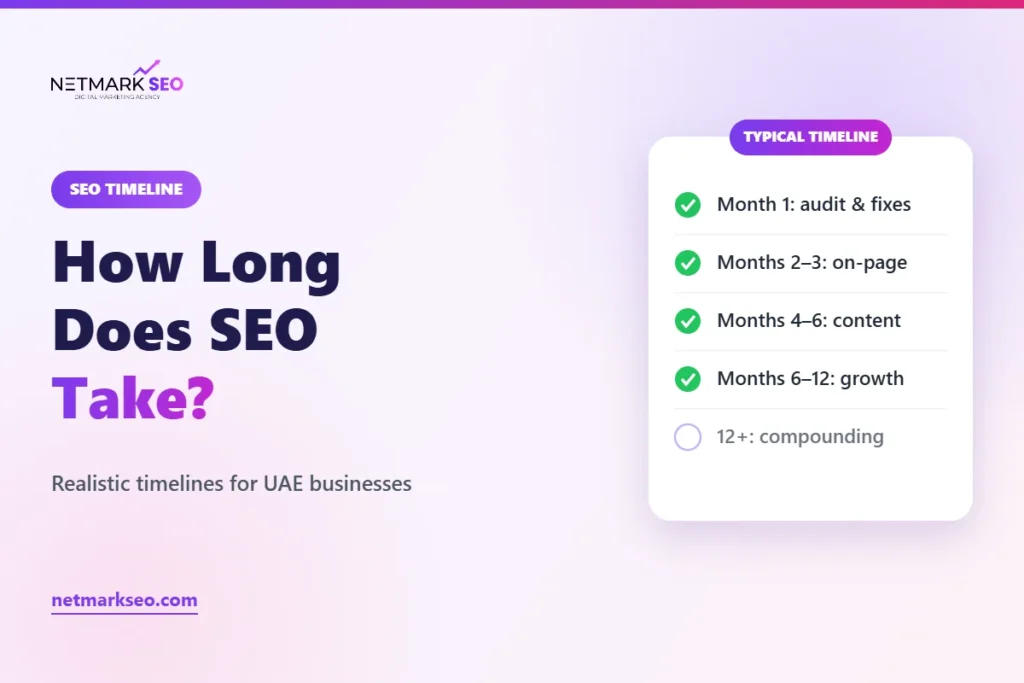
SEO usually takes four months to a year to show meaningful results. That’s Google’s own guidance: in its “Do you need an SEO?” documentation, Google says it typically takes four months to a year from when you start making changes until you see the benefit. Some improvements, like fixing a page Google couldn’t index or optimising your Google Business Profile, can show results within weeks. Ranking for competitive searches such as “SEO company in Dubai” or “dentist Dubai” usually takes longer.
This guide explains why it takes time, what to expect month by month, and what speeds it up or slows it down.
Why SEO takes time
Several things have to happen, one after another:
- Fixes have to be made. Technical problems, content and site structure take time to implement, especially when developers, approvals and content writing are involved.
- Google has to recrawl and reprocess the pages. That can take days for important pages and weeks for the rest of a site.
- Google has to re-evaluate where you belong. Rankings shift as Google sees how your updated pages compare with competitors.
- Authority builds gradually. Links, reviews, mentions and the trust they bring accumulate over months, not days.
Google’s SEO Starter Guide puts it simply: some changes can take effect within hours, others can take months, and it’s usually worth waiting a few weeks before judging whether a change worked.
A realistic timeline
This is a typical pattern for a business website with some existing history that starts a consistent SEO programme. It isn’t a guarantee: every site and market is different.
| Period | What’s happening | What you can usually measure |
|---|---|---|
| Month 1 | Audit, keyword research, tracking set-up, urgent technical fixes | Baseline; indexing problems resolved |
| Months 2–3 | On-page optimisation, content improvements, Google Business Profile, internal links | More impressions; long-tail and local searches start moving |
| Months 4–6 | New pages and guides, links and mentions, ongoing fixes | Rising clicks; first page-one rankings for less competitive terms; more enquiries |
| Months 6–12 | Content keeps building authority; competitive pages improve | Growth on core commercial keywords; SEO becomes a steady lead source |
| After 12 months | Defending and extending rankings | Compounding traffic; lower cost per lead |
Impressions usually rise before clicks, and clicks before enquiries. If impressions in Search Console are growing, Google is starting to show your pages, even before they reach page one.
What makes SEO faster
- Fixing a technical blocker. If pages were blocked from indexing or redirected wrongly, fixing it can bring traffic back quickly.
- An established domain. Sites with history, links and existing rankings move faster than brand-new domains.
- Low-competition, specific searches. “Emergency AC repair in Al Quoz” moves faster than “AC repair Dubai”.
- Quick implementation. The biggest delay we see is recommendations waiting weeks for a developer or approval.
- Local SEO. Google Business Profile improvements often show within weeks for nearby searches.
- Pages that already rank on page two. Improving pages ranked between positions 8 and 20 is usually the fastest win.
What slows SEO down
- A brand-new website or domain with no links or history
- Highly competitive markets. In Dubai that includes real estate, legal, medical, finance and, yes, SEO itself.
- Big structural changes. A redesign or migration without redirects can set you back (see our website redesign SEO checklist).
- Thin or duplicate content across many pages
- Inconsistent effort: three months of work, then three months of nothing
- Starting from a penalty or spam history
Is SEO worth it if it takes this long?
For most businesses, yes, as long as you plan for it. Paid ads stop the day you stop paying. SEO keeps bringing traffic after the work is done, and the cost per lead usually falls over time. Many businesses run Google Ads for immediate leads while SEO builds. For how to measure the return, read our guide to ROI from SEO.
How to tell whether your SEO is working early on
Before rankings and leads arrive, look for:
- More impressions and more ranking queries in Search Console
- Pages moving from positions 30–50 into 10–20
- Fewer errors in the Pages and Core Web Vitals reports
- More Google Business Profile views, calls and direction requests
- Monthly reports that show what was done and what changed
If after six months there is no growth in impressions, rankings or enquiries, and no clear explanation why, it’s reasonable to ask hard questions about the strategy.
Be careful of anyone promising fast results
Google warns site owners to be wary of SEOs who guarantee rankings or promise a “special relationship” with Google. Nobody can guarantee a #1 position. Quick-win tactics such as buying links or creating hundreds of thin pages can bring a short spike and then a long drop.
Frequently asked questions
How long does it take for a new page to rank?
A new page on an established site can be indexed within days and rank for long-tail searches within weeks. Competitive rankings usually take several months.
How long does it take for a new website to rank?
New websites usually take longer, often six months or more before significant organic traffic, because Google has little history or authority to go on.
How long until I see results from a free SEO audit?
The audit itself shows you what’s wrong. Results come from fixing it. Technical fixes can show within weeks; see what a proper SEO audit includes.
How long does it take to rank on Google Maps?
Fixing your Google Business Profile can show results within weeks. Competing in busy categories takes months of reviews and local signals. See our Google Maps SEO guide.
Plan your SEO timeline with us
If you want a realistic view of how long SEO would take for your website and market, our SEO agency in Dubai starts with a free audit and a 90-day plan. See how much SEO costs in Dubai, read our construction company SEO case study, or contact us on +971 56 568 3130.